Monday, September 20, 2010

Hugh Becomes a New England Patriot

(From Somejamesons.com) Hugh's wife, Christine, likely died in the late 1740s, relatively soon after their arrival in American and the birth of their last child, Molly. It appears that Hugh remarried a half dozen years later in the mid-1750s to Jane McHenry, a Scot like himself. It is likely that he farmed the 150 acres he had purchased in Dunbarton, NH as well as being a shoemaker. Despite, or maybe because of, his previous brush with the law "...he took a prominent part among settlers in public affairs while living in Dunbarton.

"He was one of the foremost in calling meetings of the area's inhabitants and in the transaction of public business. In 1773, Mr. Jameson was chosen costable and town collector." That is, as constable, he was an officer of the peace, with police and minor judicial duties. It was probably a good thing he had some policing authority if he was also a "collector," presumably of taxes. In a small town that likely included treasurer duties.


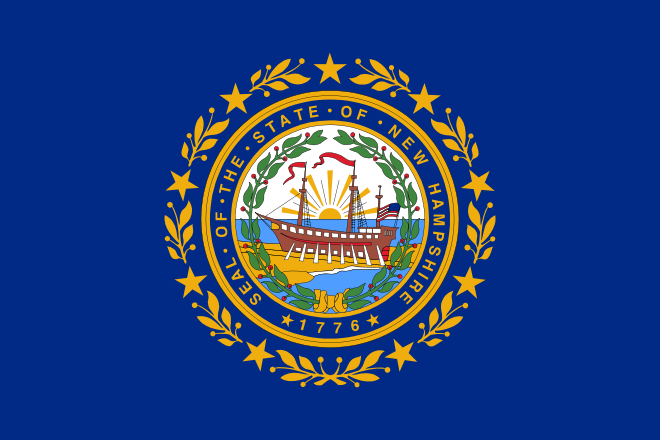
Revolutionary Flag of New Hampshire, later adopted in a slightly different form as the state flag

Hugh's sense of civic responsibility and political involvement soon took on a deeper commitment. Tensions with the British were mounting . Unlike the Dakin line of the family, these Jamesons threw their allegiance in with their new countrymen. That allegiance was about to be expressed in their participation in the Revolutionary War.


"Hugh Jameson was a Minuteman from Londonderry, New Hampshire and after the battle of Bunker Hill in 1775, although in his early 60s, marched 90 miles to Boston and back under the command of Robert Wilson and Lieutenant Joseph Hogg." By this account it would appear Hugh didn't see any "action," since his cohort arrived after Bunker Hill was fought and then returned to Dunbarton. That is not true of Alexander whose participation in the Revolutionary War we will consider in the next post.

"Hugh Jameson signed the Association Test at Dunbarton, November 25, 1776 which made him an early and bonefide patriot."


The Association Test Signed by Hugh Jameson


Wednesday, September 15, 2010

The Sheriff Comes after Hugh

A later version of the courthouse at Portsmouth, New Hampshire (Photo: CW Wycoff)

(somejamesons.com) "In June of 1753, Hugh Jameson and Robert Parinson were summoned into court in Portsmouth, NW, having been sued by Robert Gage of Coleraine, Ulster, Ireland, for not having been paid the monies due per the agreement by Jameson and Parkinson to do so, two years after arriving in America. Although both Hugh Jameson and Robert Parkinson denied owing any money both were found guilty on September 6, 1753 and ordered to pay in the amount of 18 pounds, two shillings and 4 sixpence, new tennor (sic) bills, as damages for both men, including court costs. This was apparently paid as nothing more is (recorded) of this case.

The court summons for Hugh Jameson & Robert Parkinson (Photo: Somejamesons)

"Hugh Jameson arrived in the new world apparently penniless. Documents associated with the above mentioned court case describe how he was nearly pulled off the boat at the very last moment as the ship was actually weighing anchor and about to leave port. Three men arrived unexpectedly demanding money from him. Unable to pay, a collection was taken by several of the other passengers on board to prevent that from happening.

Friday, September 10, 2010

Homestead in New Hampshire

Queen Anne (Photo: CoinLink)

Soon after their arrival in the colony of New England, Hugh Jameson and his family were living in Londonderry in the Royal Province of New Hampshire. If the name of the town sounds a little to familiar there is a reason.
A little historical context from SomeJamesons: At the turn of the century (1700), Queen Anne (1702-1714) evoked the Test Act under which the Scots in Ulster lost every benefit of the Toleration Act (1689) for which William had fought and had been gained under William of Orange (see previous post). The policies included invalidating their marriages and prohibiting them from holding office. Many left Ireland for America settling in New Hampshire in a place called Nutfield which soon became Londonderry. Wouldn't you have changed the name? King William came through again with "exempt farms" for which they paid no money. That is until the Revolutionary War. Hugh and his family, according to one article, made their way immediately upon arriving in America to Londonderry, presumably to join other Jamesons from the Bann Valley.


Dunbarton with Jameson reference at orange spot (photo: SomeJamesons)

In 1748, Hugh was one of several original petitioners to what was known as the Masonian Proprietors, owners of near by mostly unoccupied lands, for the grant of a new Township, northwest of Londonderry. Hugh Jameson's property amounted to one hundred and fifty acres. The terms of the grant were few. First, was that each "right" was with a cost of 30 pounds Sterling. Actual residence on each lot was required of the owner and his family by a certain date, the first of 30 settlers before the end of May, 1752.


Jameson House (Photo: SomeJamesons)

The original house was built in the early 1750's and at least at first may have been quite small, perhaps only about 16 x 16 foot, as was the minimum requirement at that time. We know for certain that by at least 1782 it was a four room house about 30 foot by 30 foot, with a central fireplace. There was a cellar under the structure and a "chamber" above. The current large rambling farm house incorporates in part the original structure as the northwest corner of the house. A floor plan of the current house from 1987 shows it being used as a study and an "L" shaped living room. The original fireplace is still in use.

Monday, August 30, 2010

Passage to America

(Some Jamesons) "Hugh and Christine (Whitehead) Jameson lived in or near Coleraine, County Londonderry, Ulster, Ireland, where all their children except Molly were born. On the map of Ulster in the last posting, Coleraine is to the east-north-east of Londonderry just on the other side of the River Bann. He worked as a cordwainer (shoemaker) and with their children they emigrated to America in 1746.
Sloop of the type of "Molly" (circa 1622)

"They sailed August 4, 1746, on the sloop 'Molly' from Port Rush, on the northern Coast of Ireland, for Boston, New England. The cost of the passage was agreed and bound by a contract ("note of hand" seen below) signed August 4, 1746, the actual day of sailing, with Robert Gage of Coleraine, Ireland, where Hugh and a fellow passenger, Robert Parkinson (his niece's husband), promised to pay the cost, L6-13s (for both), two years from the date of arrival in Boston.

Passage Payment Agreement:

We, Hugh Jamison and Robert Parkinson Doo bind

oursleves our ____ ____ ____ a figures in the fair

and just sum of six pounds thirteen shillings ____

lawful money of Great Britain to be paid unto Mr.

Robert Gage Mert (merchant): of Colerain in Ireland or his ______

to be paid in two years from the date here of

and after our arrival in Boston in America

as witness our hands and seals this August 4th ____

There is little to indicate why they left. In 1740-41, cold winters and poor harvests caused the Forgotten Famine during which 400,000 people died in Ireland. However, it is difficult to link that tragedy with the Jamesons' emigration five years
later.

"With him on board were his wife, Christine, and six or seven of their children, his sister, Elizabeth (Jameson) Woods, his niece, Esther (Wood) Parkinson and her husband, Robert Parkinson, as well as what is thought to be his younger brother, Thomas. Among his children were two young sons, whose names are no longer known, who died during the trip. It is said that the second boy died at the grief of the loss of his younger brother. They were both buried at sea. It is interesting to note that about two years after arriving in America, Hugh and Christine had a daughter born to them, to whom they gave the name Molly.

"Their route most likely would have been down the western coast of Ireland, the usual course of ships in those days bound for America from the northern ports of Ireland. This would have been a difficult and dangerous trip in the mid 1750's, lengthy too, especially for smaller ships like those typically sailing from Port Rush. The sloop 'Molly,' with fair sailing, would have reached the American coast in the early autumn of 1746, and probably landed her passengers in Boston, Massachusetts Bay, as that was the intended port, although the ship belonged in Salem, MA."

In the next post, we'll discover the continued influence of Robert Gage in the life of the Jamesons, Hugh's position in the town in which they settled and his role in the Revolutionary war.

Thursday, August 26, 2010

Jamesons Arrive in Templemore Parish, Ulster

The website "SomeJamesons" traces the line back to William Jameson, the first Jameson born in Ireland. William's parents came from Scotland in 1619 from the southwestern county called Argyle (or Argyllshire), as in the socks.


Argyle is the archaic spelling of Argyll, which is the southwestern (pink) section on the map


William's parents emigrated to Ireland, or more precisely Ulster (Northern Ireland), in the early 1600's. "At the beginning of the 1600's, James I, of England, began a re-population of northern Ireland with mostly Scottish Protestants. The area was at the time largely occupied by the Desmonds, who had been defeated and depleted in various rebellions with the crown during the reign of Queen Elizabeth. This forced re-population started in 1611 and was an effort by the king to colonize this here-to-fore troublesome area with a more sympathetic and supportive people. The incentives were lucrative with large quantities of land available to each immigrant. Many Scots took advantage of this offer and is undoubtedly why the ancestors of Hugh Jameson found their way to Ireland. This population was largely increased with further immigration over the next 50 years as a result of persecutions by English Kings Charles I and Charles II in their effort to establish the Church of England in Scotland."

The family took up residence and William was born in Templemore Parish of Londonderry, Northern Ireland. The distance across the channel is not very far. Notice Scotland in the upper right hand corner of the map of Northern Ireland. William (1) was born in 1646.


"The Scottish colonists resided in Ireland over several decades during the middle 1600's. They lived somewhat autonomously, retaining their culture and traditions. Intermarriage of Scots with the Irish were exceedingly rare, so that the Scotch race remained nearly as distinct as it was prior to its settlement in this new land. They attended their own churches and continued life pretty much as it was known to them in Scotland... The Jamesons in general were said to have been a robust, active, muscular, and prolific race of people undoubtedly descended from the son of James or Jamie..."

"William Jameson was said to be a vigorous Scotchman, who was thought to have served in the defense of Londonderry during the siege of 1689, and probably the Battle of Boyne in 1690 with distinguished gallantry and such bravery that he was made free from taxation throughout the British dominion by William III, Prince of Orange."


Battle of Boyne (Wikipedia)

The Battle of Boyne was a decisive battle in turning back King James II of England, Scotland and Ireland. He was Catholic and for him the war was an attempt to regain the throne so he could create sovereignty for Ireland, religious freedom and the right to own land for Catholics. No surprise, most of his soldiers were Irish Catholics.

Conversely, for William of Orange and his soldiers, the war was about maintaining Protestant and English rule against the fear that if James retook the throne he would take their land and or kill large numbers of them.


William of Orange (Wikipedia)

Saturday, July 17, 2010

Some Jamesons

Isaac & Laura Jameson Dakin on Laurel Glen circa 1890


Laura Jameson Dakin was an equal partner with Isaac in their contribution to life in Knight's Ferry. What prepared her for that role? Where did her people come from and what pressures, accomplishments and other experiences shaped their lives? Those are questions that we will explore over the next several posts. Before we get started a couple of preliminaries. I am deeply indebted to the Jamesons, especially John Jameson, who put together material for http://www.somejamesons.com/. Much of the information that follows comes from that website and the sources cited there.

A preview of major players in the postings/generations to follow may be helpful to keep them straight. As usual there are fathers and sons with the same name which tends to confuse things. In that regard, the first father and son combination does not disappoint.

William Jameson (1) born 1646, was the first Jameson to be born in Northern Ireland. The family was from Scotland. William (1) was a war hero in the Battle of Boyne and received a significant reward for his service. His son William (2) was also born in Northern Ireland about 1675. His son Hugh was a pivotal figure.


Hugh Jameson, born 1713, and his wife (first wife in the family for whom we have a name), Christine Whitehead, were the brave and/or desperate souls who fled Ireland for America. We'll explore the circumstances that likely forced them to leave Ireland and see some of the documents that mark that passage and its differed payment.


After Christine died, William (2) met and married Jane McHenry in New Hampshire. Their first born (1760) was Alexander (1). Alexander was Laura Maria Jameson Dakin's grandfather. We gain some interesting insights into the social life of the early colonies through an arrangement Alexander and his brother, Daniel, made with their parents.


Alexander's (1) family broke up after the death of his first wife, Janet Brown Jameson around 1800. When his mother died and he was little more than 3 years old, Alexander (2) was taken in by his aunt and uncle, Zuar and Mary (Brown) Eldridge also of New Hampshire. There is an interesting story (or perhaps legend) around the break up of the family. Alexander (2) is also the first Jameson whose picture we have to post.


Up until Alexander (2), almost everybody is still in New Hampshire. That is, until we find Laura Maria Jameson getting ready to marry Isaac Dakin in Knight's Ferry, CA, in 1859. I'm hoping I'll know a lot more about how Laura got to California by the time that posting comes long.


Tuesday, June 1, 2010

Dakins Move On

Dakin Blacksmith Shop rebuilt after a fire that destroyed it and now used as a firestation.
Alice Arata stands in front. (photo: 1993)


For twenty years, the Dakins were indelibly intertwined in the fortunes of Knights Ferry. As they grew older together, Laura and Isaac decided to transition to a new vocation. For a long time Isaac had been reading the Horticulturalist's Monthly. Business had been falling off steadily. The goldfields no longer held the attraction for young men seeking their fortune. The new railroad took the remaining business elsewhere. Big freighters no longer rumbled day and night through the tiney way station by the Stanislaus.


Selling Isaac's interest in the blacksmith's shop would be difficult. But, in the fall of 1877, he succeeded in selling the smithy and the Dakins were free to move to Laurel Glen in Soquel. There Isaac would take up horticulture along with his children, most notibly his son, Henry.


The beautiful home that saw so much history being made within its walls was also sold. Most owners since then have taken pride in keeping the home and grounds in top condition. Today, if Laura and Isaac were to return to Knights Ferry, they would instantly recognize the spot where they began married life together. where their children were born and where many happy memberies are stored within its walls. (End of Criswell content)